
The Definition: What Is a Betting Exchange?
A betting exchange is a marketplace where bettors trade with each other directly — no bookmaker takes the opposite side of any bet. The exchange operator provides the platform infrastructure, matches opposing bets algorithmically, handles settlement, and charges a commission on winning positions. The operator has no financial interest in any specific outcome: it profits from transaction volume regardless of who wins or loses.
This structural difference is not cosmetic — it fundamentally changes the economics of betting for the bettor. Without a bookmaker margin built into the odds and without any business incentive to restrict profitable accounts, exchanges represent the closest thing to a fair market that exists in sports betting.
The concept originated from financial market structure. Just as a stock exchange matches buyers and sellers without taking positions itself, a betting exchange matches backers and layers at prices determined by supply and demand rather than by a single price-setter.
How a Betting Exchange Differs from a Bookmaker
The difference is structural, not superficial. A bookmaker operates on an adversarial model: it takes the opposite side of your bets and profits directly when you lose. To protect this model, bookmakers build an overround of 5–12% into every market — a built-in mathematical edge that operates against every customer on every bet.
When a bettor consistently beats this margin, they become unprofitable for the bookmaker. The bookmaker's rational response is to restrict stakes or close the account. This is why every serious bettor eventually encounters account limitations — it is not arbitrary, it is structural.
An exchange has no overround. Prices are set by market participants through competitive bidding. The exchange earns the same commission whether you win or lose. A profitable bettor generates more turnover and pays more commission — they are the best kind of customer for an exchange. This is why exchanges do not restrict winning accounts as a matter of business policy.
For a full comparison of both models, see our dedicated guide: betting exchange vs bookmaker.
Major Betting Exchange Platforms
Four exchanges dominate the global market:
- Betfair — the largest exchange by liquidity globally, founded in 2000 and operating in most regulated markets. Dominant for UK/Irish horse racing and European football. Standard commission of 5%, reduced by loyalty discounts. Geographic restrictions apply in some jurisdictions.
- Smarkets — lower commission (2% standard rate) with competitive liquidity on major events. Particularly active in UK and European sport. Preferred by professional bettors optimising for commission cost on high-volume activity.
- Matchbook — commission-based structure similar to Smarkets, with a focus on high-stakes football and racing markets. Used by professional bettors for specific major market trading.
- Betdaq — smaller market share and thinner liquidity than the above, but occasionally competitive on specific markets. Owned by Ladbrokes Coral (Entain) since 2013.
Each platform differs materially in commission structure, liquidity depth, geographic availability, and mobile offering. For a comprehensive comparison, see best betting exchanges 2026.
Back and Lay: The Core Mechanic
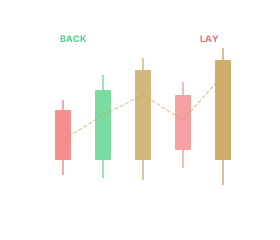
Every market on a betting exchange operates with two sides, which is what distinguishes exchanges from all other betting formats:
- Back a selection — you bet that an outcome will occur. This is functionally identical to a traditional bet placed at a bookmaker, but at exchange prices (typically sharper).
- Lay a selection — you bet that an outcome will not occur. You take the role of the bookmaker for that specific bet, accepting another bettor's back wager and paying out if the outcome happens.
This two-sided structure enables strategies that are impossible with traditional bookmakers: exchange arbitrage, matched betting to extract free bet value, pre-event and in-play trading to lock in profits on odds movements, and sophisticated hedging across multiple selections.
Full mechanics, liability calculations, and worked examples are in our back and lay betting guide.
Who Uses Betting Exchanges?
Exchanges attract a qualitatively different audience to standard bookmakers. The primary user profiles:
- Sharp value bettors — using exchange prices as the sharpest available odds, free from bookmaker margin. Also use exchange prices as the reference for closing line value analysis.
- Arbitrageurs — using the lay side to neutralise bookmaker positions, creating risk-free profit where back odds exceed exchange lay odds (after commission).
- Matched bettors — laying qualifying bets to extract net value from bookmaker free bet promotions with minimal net exposure.
- Exchange traders — entering and exiting back and lay positions as odds move, generating P&L from price movement without caring about the event result.
- Professional bettors — using the unrestricted, low-margin exchange environment as the primary or secondary market alongside Asian book access.
Each profile has distinct priorities and different optimal exchange strategies. Our guide to bettor profiles on exchanges covers each in depth.
Exchange Limitations and When a Broker Is the Answer
Despite their structural advantages, exchanges have real limitations that matter for professional bettors operating at scale:
- Geographic restrictions — Betfair is blocked or heavily restricted across much of Asia, Latin America, and other markets. Bettors in these jurisdictions cannot access Betfair directly.
- Liquidity constraints — smaller markets, lower-division football, and non-mainstream sports often have thin order books. Large-stake execution at your target price may be impossible without moving the market against yourself.
- No Asian handicap coverage — exchanges do not offer Asian handicap football markets with the depth available through Asian books. This is an entirely separate liquidity ecosystem.
- Betfair Premium Charge — accounts that consistently win above a defined threshold face an additional levy that can push effective commission well above 20% for the most profitable accounts.
A sports betting broker addresses all of these limitations. Leading brokers include exchange access within a multi-book infrastructure that combines exchange liquidity with Asian market connectivity, higher total stake capacity, and unified account management — without geographic restrictions. See why bettors use brokers to access exchanges and best betting brokers 2026 for the next step.