
The Order Book Model
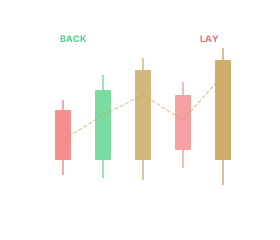
A betting exchange operates like a financial trading exchange. Every market — a football match, a horse race, a tennis set — has an order book with two sides: back orders (bets that an outcome will occur) and lay orders (bets that it will not). Participants submit orders at prices they're willing to accept, and the exchange's matching engine pairs opposing orders when prices align.
This is fundamentally different from a bookmaker, which sets prices unilaterally and takes the opposite position on every bet. On an exchange, no single entity sets the price. The market price emerges from the collective supply and demand of all participants submitting orders simultaneously. The "best back price" displayed is the highest price any layer is currently willing to offer. The "best lay price" is the lowest price any backer is willing to accept.
This structure is why exchange prices are considered the most accurate reflection of true probability — they are the result of competitive price discovery among thousands of participants, not the output of a single bookmaker's pricing model.
How Bets Are Matched
When you submit a back bet at a specific price, your order enters the queue. If an existing lay offer in the book matches your requested price exactly, the bet is matched immediately and confirmed. If no counter-order exists at your price, your order waits in the book.
The matching engine processes orders on a price-time priority basis: the best available price is matched first; among orders at the same price, the earliest submitted order gets priority. This is identical to how equity trading exchanges process limit orders.
Once matched, the bet is locked. The back and lay stakes are committed and held by the exchange's settlement system. At event resolution, the exchange calculates the outcome, credits the winner, and deducts commission before releasing funds.
This continuous matching process means that the odds displayed on an exchange at any moment represent the current best available prices — a live, real-time reflection of collective market opinion about the event. They are not static prices set at market open and held throughout.
Back and Lay: The Two Sides of Every Exchange Market
Every exchange market has two active sides, which is what distinguishes exchanges from all other betting infrastructure:
- Back bet — you bet that a specific outcome will happen. Equivalent to a traditional bet at a bookmaker, but executed at exchange prices (no overround).
- Lay bet — you bet that an outcome will not happen. You take the role of the bookmaker for that specific selection, accepting a backer's wager and paying out at the offered odds if the outcome occurs.
The lay function is what enables arbitrage, matched betting, and exchange trading — strategies that require the ability to take both sides of a market. For a full breakdown of how lay bets work, liability calculations, and worked examples, see our back and lay betting guide.
Unmatched and Partially Matched Bets
Not all exchange orders are matched instantly. If you request a back at 2.50 but the best available lay price is 2.40, your order sits unmatched in the book at your requested price. You have three options:
- Leave the order — wait for the market to move to your price as sentiment shifts or new orders arrive.
- Revise the price — adjust your requested price toward the current market to accelerate matching.
- Cancel — withdraw the unmatched order entirely and receive your funds back immediately.
Partial matching is routine on active markets. If you submit a back for £500 at a given price but only £300 of lay liquidity exists at that price, £300 is matched and confirmed while £200 remains in the order book pending further liquidity. Your account reflects the matched portion as an active bet and holds the unmatched portion separately.
Unmatched funds are never at risk — they are held in a temporary queue state and returned in full if the order is cancelled or the market closes without full matching occurring.
Market Liquidity in Practice
Exchange liquidity is the total volume of orders available in a market at any given moment. It determines whether you can execute at your desired price, at your full stake, without materially moving the market against you.
Liquidity varies significantly by sport, competition level, time before event start, and platform. Betfair's Premier League football markets routinely record tens of millions in matched volume per match — deep enough for substantial professional stakes without market impact. The same exchange's markets on lower-division football or niche sports may have only tens of thousands in total volume, making large-stake execution at precise prices difficult or impossible.
Liquidity also concentrates around event start and during in-play for major markets — thin in the days before an event, then rapidly deepening as kickoff approaches. For professional bettors, this means optimal execution windows and the need to time orders accordingly.
For a full analysis of liquidity across markets and platforms, including implications for large-stake professional use, see our exchange liquidity guide.
The Role of Market Makers
Professional market makers actively participate in exchange markets to maintain order book depth. They simultaneously offer back and lay prices across multiple selections at competitive spreads, earning the bid-ask differential while managing balanced risk across a portfolio of positions.
Market makers perform the same function as financial market makers in equity or FX markets: they provide liquidity that passive participants can trade against, for a fee (the spread). When you back a selection at the best available price on an exchange, you are frequently trading against a market maker who has laid at that price as part of a systematic matched book.
This market-making activity is what keeps exchange prices sharp and spreads tight on major markets. On minor markets, fewer or no market makers participate — which is why bid-ask spreads widen and liquidity thins on smaller events.
Commission and Cost Structure
Unlike bookmakers who charge you via the overround on every bet placed, exchanges charge commission only on winning bets — specifically on net market profit. Key platform rates:
- Betfair — 5% standard commission on net market winnings, reduced by Betfair's Market Base Rate discount (applied based on your volume and profitability profile).
- Smarkets — 2% standard commission, flat rate. No tiered charge system.
- Matchbook — variable rate, competitive for large-stake major market activity.
Commission applies to your net position in each market. If you back and then lay within the same market (a trading position), commission applies to your net P&L, not to gross turnover. This makes trading strategies more capital-efficient than they might first appear.
Betfair additionally applies a Premium Charge to accounts that consistently win above a defined threshold relative to their commission contribution. This premium levy can push effective commission rates significantly higher for the most profitable accounts — a key consideration for professional bettors evaluating exchange vs broker infrastructure. Full analysis in our exchange commission guide.
A top-rated betting broker combines exchange lines with Asian book liquidity in one account.