
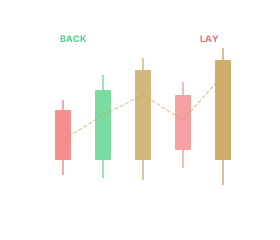
What Is a Betting Exchange?
A betting exchange is a marketplace where bettors trade with each other rather than against a bookmaker. The exchange operator provides the platform, matches opposing bets, handles settlements, and charges a commission on winning positions. The operator has no financial interest in any outcome — they profit from volume regardless of results.
This structural difference from a traditional bookmaker has profound implications for pricing, account treatment, and long-term profitability for professional bettors. For a complete definition, see our dedicated guide: what is a betting exchange.
How Exchanges Work
Exchanges operate on an order book model, similar to financial markets. When you want to back an outcome at a specific price, your request sits in the order book until a counter-party is willing to lay that same outcome at your requested price. When the prices match, the bet is confirmed.
Unmatched bets remain in the queue and may be partially matched as liquidity becomes available. The price you see on an exchange is the best available price that can be matched immediately — the actual "market" price as set by all participants. There is no bookmaker setting prices; the market itself finds the price.
Our detailed guide to how betting exchanges work covers the order book mechanics, market liquidity, and the role of professional market makers in depth.
Back and Lay: The Core Mechanic
The defining feature of exchanges that distinguishes them from all other betting formats is the ability to lay outcomes — to bet against an outcome occurring, effectively acting as the bookmaker for that specific event.
A back bet is a standard bet: you wager that something will happen. A lay bet is the opposite: you wager that it will not happen, and you take on liability proportional to the odds. If a player is priced at 3.0 to win a tournament, laying them for £100 means you win £100 if they lose but pay out £200 (£100 × (3.0–1)) if they win.
This two-sided market is what enables arbitrage via exchanges, matched betting, and trading strategies. Full explanation in our back and lay betting guide.
Exchange vs Bookmaker
The fundamental economics differ in two critical ways:
Margin structure: A bookmaker builds a 5–12% overround into every market — every bet you place carries this cost. An exchange charges 2–5% commission on winning bets only. For bettors with a genuine long-term edge, this difference in cost structure is significant over thousands of bets.
Account treatment: Bookmakers systematically restrict accounts that win consistently. Exchanges do not operate this way — they earn from volume, not from bettor losses. Winning accounts are not a threat to the exchange's business model. This is one of the primary reasons professional bettors migrate from bookmakers to exchanges (and brokers with exchange access).
For a detailed breakdown, see our exchange vs bookmaker comparison.
Who Uses Betting Exchanges
Exchanges attract a different demographic to standard bookmakers. The key user profiles include:
- Arbitrageurs — using lay bets to create two-sided guaranteed profit positions
- Matched bettors — laying outcomes to neutralise bookmaker free bets and bonuses
- Exchange traders — trading odds movements before settlement for financial P&L
- Value bettors — using exchange prices as the sharpest available reference odds
- Sharp professionals — using the unrestricted, low-margin exchange environment as their primary market
Each profile has different priorities and different reasons for choosing exchanges. Our guide to bettor profiles on exchanges covers each in detail.
When a Broker Is the Better Choice
Exchanges are powerful tools, but they have structural limitations that a betting broker addresses:
- Geographic access: Betfair is unavailable in many countries. A broker with exchange access solves this without the individual geographic restriction.
- Asian market integration: Exchanges cover European and some global sports well, but Asian book liquidity — particularly for Asian handicap football — is an entirely separate ecosystem. A broker can combine exchange access with Asian book connectivity in a single account.
- Premium Charge mitigation: Betfair's Premium Charge can erode profits for consistently winning accounts. Brokers who access exchanges as institutional clients may operate under different charge structures.
- Unified management: A broker provides a single account, single wallet, and single interface across multiple sources — including exchanges. This operational simplicity is valuable at professional betting scale.
For the full comparison, see our guide on exchange vs broker — which do you need? and our dedicated piece on why bettors use brokers to access exchanges.
Exchange Guides: Full Index
This section provides the complete educational resource on betting exchanges for professional bettors. Work through the guides in order for a structured understanding, or jump directly to the topic most relevant to your strategy.
- What Is a Betting Exchange? — Definition, major platforms, and the peer-to-peer model
- How Betting Exchanges Work — Order books, matching mechanics, and market liquidity
- Back and Lay Betting Explained — The two-sided market mechanic in detail
- Betting Exchange vs Bookmaker — Margin, pricing, and account treatment
- Betting Exchange vs Broker — Infrastructure comparison for professional use
- Betting Exchange Liquidity — Depth of market and execution implications
- Betting Exchange Commission — Fee structures and the Betfair Premium Charge
- Why Bettors Use Brokers to Access Exchanges — The access and infrastructure case
- Risks, Limits, and Restrictions on Exchanges — What can go wrong and how to manage it
- Who Uses Betting Exchanges — Five bettor profiles explained
- Best Betting Exchanges 2026 — Platform comparison for professional bettors