
What Is European Handicap?
European handicap (also called 3-way handicap or Asian handicap without the draw elimination) applies a whole-goal advantage to one team but retains three possible outcomes: home win, draw, and away win — all evaluated after the handicap adjustment. If Team A is given +1, a draw in the adjusted score is still a distinct outcome a bettor can back.
European handicap is common on betting exchanges and is offered by most European sportsbooks alongside 1X2 markets. It shares the same underlying concept as Asian handicap — levelling the field between unevenly matched sides — but its three-way structure makes it a different product in terms of margin, pricing efficiency, and betting behaviour.
To understand how Asian handicap works from first principles, start with our guide: What Is Asian Handicap?
Outcome Structure: Two Outcomes vs Three
The fundamental difference is how the draw is handled:
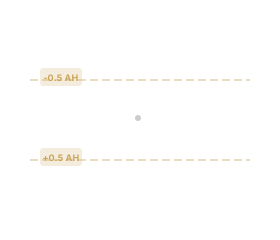
- Asian handicap: uses fractional lines (e.g., -0.5, -1.5, or quarter-ball splits like -0.25) to ensure only two outcomes are possible. The draw is algebraically impossible because no team can score a half-goal. This creates a binary market with two competing probabilities that must sum to 100% (minus margin).
- European handicap: uses whole-number lines only. A -1 European handicap on Team A means: Team A -1 win (Team A wins by 2+), draw at -1 (Team A wins by exactly 1), Team A -1 loss (draw or Team B win). Three outcomes, three prices, three margins.
For professional bettors, a binary market is preferable. Estimating the probability of two outcomes is more tractable than modelling three, and the two-way market structure reduces the scope for bookmaker margin manipulation. The back and lay mechanics of betting exchanges are built on two-outcome markets — see back and lay betting explained for how this connects to exchange trading.
Margin Comparison: The Real Cost Difference
Asian handicap consistently delivers lower overround than European handicap. Here is a typical comparison on the same match:
| Format | Outcomes | Typical overround | Implied margin |
|---|---|---|---|
| Asian Handicap (sharp book) | 2 | 101.5–102% | 1.5–2% |
| European Handicap (soft book) | 3 | 105–108% | 5–8% |
| 1X2 (standard market) | 3 | 106–112% | 6–12% |
For a bettor placing 1,000 bets per year at £500 average stake, the difference between a 2% and a 6% margin represents £20,000 in additional cost per year — purely from market selection. Over a multi-year horizon, this margin drag is often the difference between a profitable and unprofitable operation, regardless of betting edge.
Push Rules and Void Bets
In Asian handicap with whole-number lines (e.g., -1.0, -2.0), a push occurs when the margin of victory exactly equals the handicap. The bet is voided and stakes returned. This is neither a win nor a loss — it simply did not settle.
In European handicap, the same scenario is not a push. It settles as the "draw" outcome at the adjusted scoreline — a distinct bet that pays at odds, loses, or wins depending on how you backed it. There is no void.
The practical implication: on whole-number Asian handicaps in close matches, there is a meaningful probability of a push. Half-ball Asian handicaps eliminate this entirely. Quarter-ball handicaps split the stake and create a partial push on one half. For a full breakdown of quarter-ball mechanics, see: Asian handicap quarter goals explained.
Liquidity and Stake Limits
Asian handicap markets on dedicated Asian books and through brokers with Asian access carry substantially higher limits than European handicap markets on recreational sportsbooks:
- Sharp Asian books and brokers routinely accept five-figure stakes on top football Asian handicap markets.
- European soft books frequently cap handicap markets at £200–£2,000 for recreational players, with lower caps or manual review for identified sharp accounts.
- Liquidity on Asian handicap exchanges (where available) can be significant on major matches but thins rapidly on niche leagues.
For high-stakes bettors, this limit difference alone often determines market selection. See how brokers help with stake access: Asian betting brokers guide.
Which Format Should You Use?
For professional betting purposes, Asian handicap is superior to European handicap on every measurable dimension where both are available: lower margin, sharper pricing, higher limits, and cleaner two-way probability structure. European handicap retains a role only where Asian handicap is not offered — niche sports, smaller leagues, or certain bookmakers that do not carry Asian-format lines.
If you are currently betting on European handicap markets and the same event is available as Asian handicap elsewhere, the immediate action is to find access to the Asian line. The margin savings materialise immediately.
Sharp Asian lines through a single broker account — no geographic restrictions, higher limits.
Accessing Asian Handicap Lines
The sharpest Asian handicap prices are not available through standard European bookmakers. They originate from dedicated Asian books — major Asian operators, Pinnacle — and are aggregated through professional betting brokers. For bettors outside Asia, the practical route to Asian handicap markets is:
- Direct account with Pinnacle — available in many jurisdictions; offers sharp two-way handicap markets with 1–2% margins. Stake limits are high but not unlimited.
- Asian betting broker — provides access to multiple Asian books and Pinnacle through a single account. Eliminates geographic restrictions and consolidates account management. See: how to access Asian bookmakers.
- Betting exchange — Betfair and Smarkets offer Asian handicap markets with no bookmaker margin, only commission. Subject to liquidity and geographic restrictions in some markets.
For a complete list of top Asian-focused brokers, see our ranking: best betting brokers 2026.